
Have you ever been fully aware of a pattern you want to change, and then, at the end of the day, realized you did the exact same thing anyway?
You know you’re wasting time on Instagram. (Guilty!) And you know you want to respond differently to your partner. You have the insight. And yet the behavior doesn’t move.
That’s the gap between knowing and doing, and it’s what I want to talk about today.
The Carpenter Ant Problem
Recently, my London apartment had a carpenter ant problem. I watched them file around the same track over and over, around and around and around, never deviating.
That’s exactly how our habits work. We repeat the same loop and then wonder why we keep getting the same outcome. Real change doesn’t come from having more insight. It comes from stepping off the ant trail — choosing, in a specific moment, to do something different than the habitual thing.
The Gap Is Real (Even When It Doesn’t Feel Like It)
According to Florien Cramwinckel of the Behavioral Times:
“Psychologists have a name for this puzzle: the intention–behavior gap. It describes the discrepancy between what people intend to do and what they actually end up doing. And this gap is huuuuuge.
Meta-analyses show that even strong intentions explain less than one-third of actual behavior (Sheeran & Webb, 2016). That means the majority of our behavior cannot be predicted just by looking at what people say they want.”
Most days, it feels like there’s no gap at all — like you’re already reacting before you’ve even had a thought. But the gap is there. It’s just small, and it’s easy to miss.
Here’s how it actually breaks down:
- A sensation or feeling arises. Restlessness, boredom, anxiety, “I don’t know what to do with myself.”
- You make a decision — and it is a decision, even when it doesn’t feel like one. Picking up the phone. Checking the feed. Sending the reactive text.
- The spiral starts. One action leads to the next, and twenty minutes later you’re looking back thinking, “Wait — I could have chosen differently right there.”
That middle step, the decision, is where the gap lives. It’s the space between the trigger and the response, and it’s where all the leverage is.
**Read more about Dr. Jud Brewer’s research on habit loops here. **
You Don’t Have to Catch It Instantly
Here’s the shift that actually matters: you don’t need to catch yourself the moment the impulse hits. You can catch it after.
Ideally, you notice yourself reaching for the phone and you stop. But even if the phone is already in your hand, you can catch it 30 seconds later and put it down. That still counts. It’s still progress. And the goal isn’t perfection. It’s expanding the gap a little more each time.

How to Actually Expand the Gap
A few things help:
- Get curious about the sensation. What’s driving this? What am I feeling right before I reach for the habitual thing?
- Ask yourself in the moment: What am I doing right now? What pattern am I falling into? What am I actually trying to avoid?
- Observe without jumping into the pattern. Then ask, “What am I going to do instead?” and actually choose it.
Over time, these small choices compound. Your days start looking different. Then your weeks and your months. That’s how the needle actually moves.
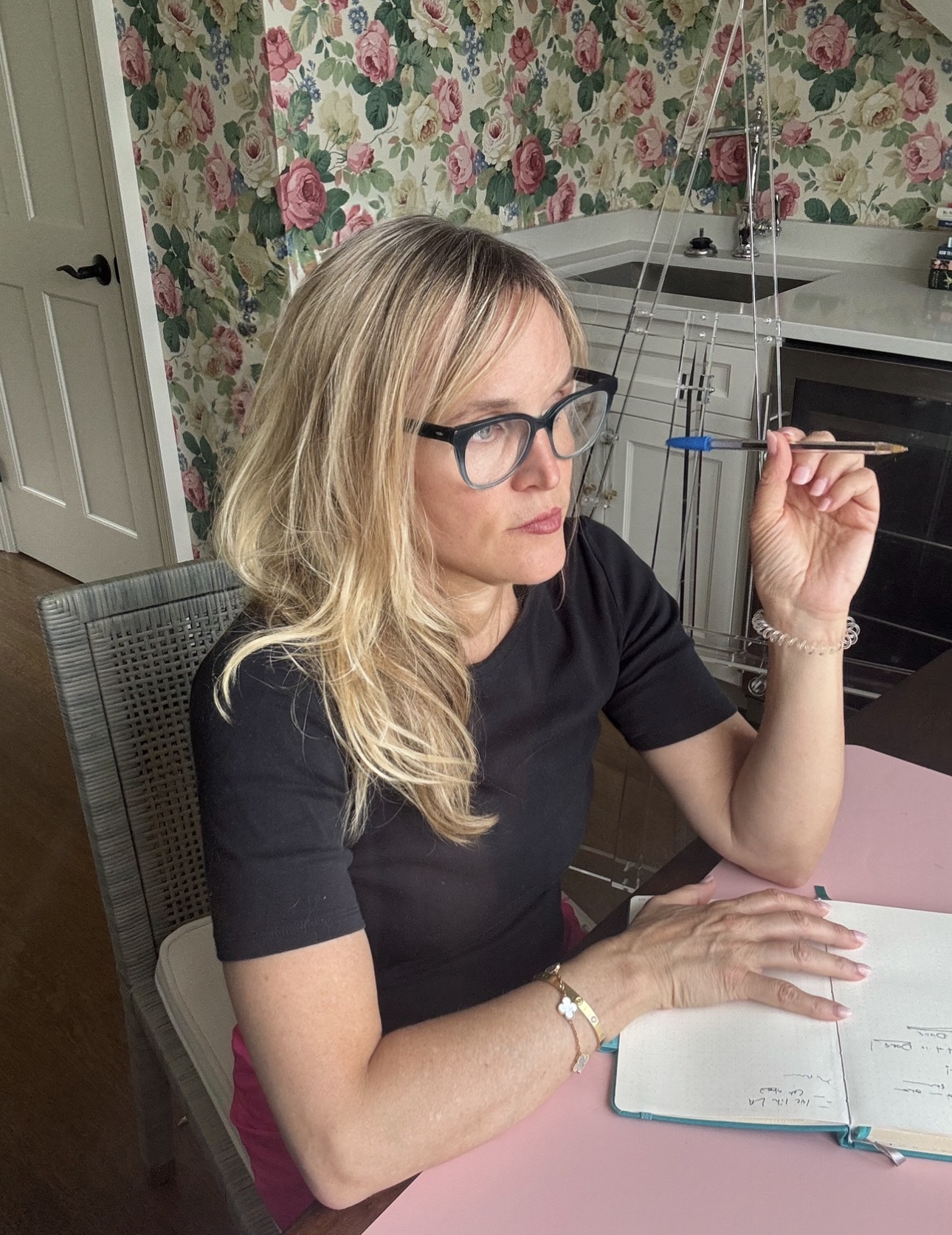
One practical tool I love: bullet journaling. Alongside the usual task list, write down your aspirational list, the things you’d genuinely love to do with your time (read two chapters, sit in the garden, watch the sunrise). When you’re in one of those in-between moments where you’d normally default to mindless scrolling, that list is a reminder of the version of you that you’re actually trying to become.
Catching the Boulder Before It Goes Down the Hill
It’s really about catching the boulder before it starts rolling. The choice to look, click, or scroll is still a choice, even when it doesn’t feel like one. And once you see it as a choice, you get your power back.

What This Has to Do With Love
This isn’t just about phones and scrolling. The same gap shows up when you’re trying to attract a relationship, or step into a higher version of your life.
It’s easy to picture the relationship you want. You can envision the partner, the connection, the way it would feel.
But the real question isn’t what that life looks like. It’s who you are inside it. What does the version of you who has that relationship feel like day to day? How does she move through her mornings? What does she say yes to, and what does she let go of?
That version of you doesn’t show up all at once. She shows up in the small decisions: the ones so minor they barely register as choices at all.
Do you look at the Facebook page that leaves you feeling worse instead of better?
Do you stay in the group chat that keeps you anchored to an old version of your life?
Do you make time for the walk, the journal, the quiet hour that actually aligns with who you’re becoming, or do you default to the habit that’s familiar but doesn’t serve you?
None of these individual choices feel like they’re about love. But they’re all training your nervous system for what you’ll accept as familiar, and familiarity is what we’re unconsciously drawn toward, even when it isn’t what we actually want.
If you want a relationship or a life that feels different, the evidence has to start showing up in the small everyday moments first. And this is not because the big vision doesn’t matter, but because the big vision is built out of a thousand small ones.
So the same practice applies here too: notice the moment.
Notice which version of yourself is making the choice. The one still circling the old pattern, or the one already living as though the relationship, the life, the version of you, is already here. Choose from there, even in the small moment. That’s where it’s actually built.
Three Questions to Ask Yourself This Week
- What’s a habit I’m engaging in that isn’t in alignment with who I want to be?
- What immediately precedes it? What’s the feeling or trigger that shows up right before I reach for it?
- What could I do instead in that exact moment?
You likely won’t master this in one sitting. This is an integration practice, not a switch you flip.
If all you do this week is notice the moment you’re making the choice, that’s a win. Awareness is what gives you the chance to choose differently next time.
It’s not about the ten seconds. It’s about the millisecond inside where you get to choose again.
🌸Thanks for Reading
You read this article for a reason today. If you are tired of just reading about self-worth, mindset, and relationships, and you are ready to actively break the loops that keep you feeling stuck, anxious, or lonely—let's chat. You don't have to navigate your next chapter alone. Click below to claim a completely free, private 15-Minute Clarity & Breakthrough Session directly on my calendar. Zero sales pressure. Just pure perspective on your exact situation.